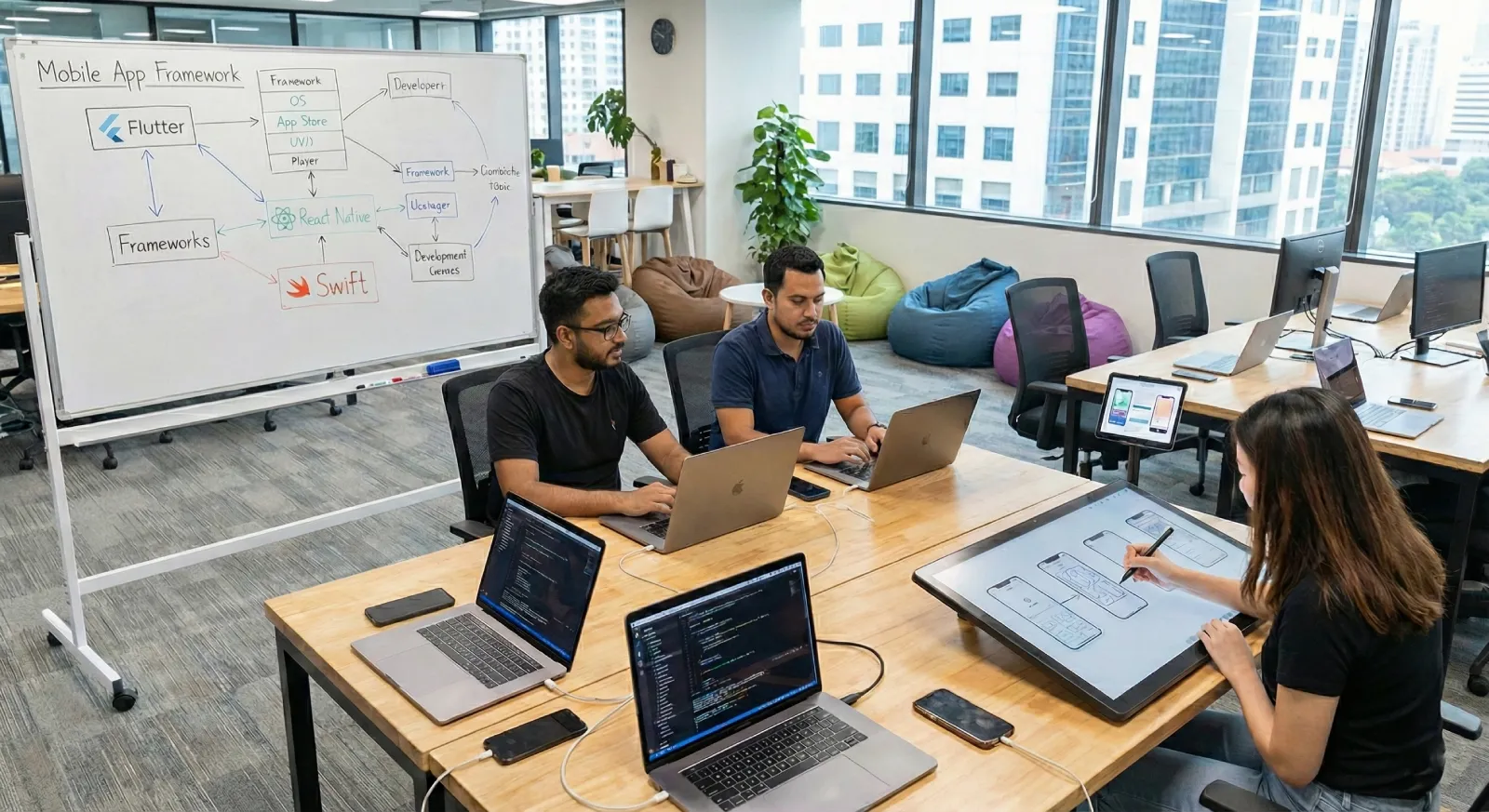
In the high-stakes world of digital product development, choosing the best mobile app framework is often the decision that determines your time-to-market, burn rate, and long-term scalability.
For years, the debate was binary: Native vs. Cross-Platform. You either chose performance at high cost (Native) or speed at the cost of quality (Hybrid). But in 2026, the landscape has shifted. With the maturity of React Native, the dominance of Flutter, and the disruptive rise of Kotlin Multiplatform (KMP), the lines have blurred.
This isn’t just a list of tools. This is a strategic deep dive for CTOs, VPs of Engineering, and Founders who need to understand the architectural implications of their stack. Whether you are building the next unicorn or digitally transforming an enterprise, this guide will help you select the best framework for mobile app development tailored to your business goals.
The Mobile Development Landscape in 2026
Before diving into specific tools, we must categorize the current ecosystem. The market has moved away from «WebView-based» hybrids (like Ionic/Cordova) toward «Native-compiling» cross-platform solutions.
- Native (Swift/Kotlin): The gold standard for performance and hardware access.
- Cross-Platform (React Native/Flutter): The market leaders. They write once and deploy to both iOS and Android with near-native performance.
- Multiplatform (KMP): The hybrid approach where you share business logic but keep the UI native.
Understanding this hierarchy is crucial to identifying the best mobile app framework for your specific constraints.
The Titans: Top Frameworks Analyzed
Let’s break down the market leaders based on architecture, ecosystem, and business fit.
React Native: The Ecosystem Juggernaut
Created by Meta (Facebook), React Native remains the most popular choice for startups and scale-ups, primarily due to its connection with the JavaScript ecosystem.
- How it works: It uses a «Bridge» (though the new Fabric architecture is removing this bottleneck) to communicate between JavaScript code and native platform components.
- Best for: Teams with existing web talent (React.js), data-driven apps, and products requiring frequent Over-the-Air (OTA) updates.
- The Business Case: If you are looking for the best react native apps as proof, look no further than Instagram, Airbnb, and Discord. These companies leverage code sharing between web and mobile to move at lightning speed.
- Pros:
- Huge talent pool (easy to hire JS developers).
- OTA Updates (bypass App Store reviews for small fixes).
- Mature ecosystem of libraries.
- Cons:
- Performance can lag in complex animation scenarios if not optimized.
- Dependency management can become a headache in large codebases.
Flutter: The Performance Powerhouse
Google’s UI toolkit has challenged React Native’s dominance by solving the «bridge» problem.
- How it works: Flutter doesn’t use native OEM widgets. Instead, it carries its own rendering engine (Skia/Impeller) to draw pixels directly on the screen. This guarantees 60fps/120fps performance on almost any device.
- Best for: Highly visual apps, brand-heavy experiences, and products where UI consistency across platforms is non-negotiable. It is widely considered the best cross platform framework for UI fidelity.
- The Business Case: Companies like Nubank and BMW use Flutter to ensure their apps look identical on an iPhone 15 and a budget Android device.
- Pros:
- «Hot Reload» offers the best developer experience (DX) in the market.
- Single codebase for Mobile, Web, and Desktop.
- Pixel-perfect rendering.
- Cons:
- Larger app size compared to native.
- Dart language is niche; hiring senior Flutter engineers can be harder than hiring React developers.
Kotlin Multiplatform (KMP): The Enterprise Choice
KMP is rapidly becoming the best framework for Android app development teams that want to support iOS without abandoning their native roots.
- How it works: Unlike Flutter or RN, KMP doesn’t force you to share the UI. You share the «Business Logic» (Networking, Data Storage, Analytics) while writing the UI natively in SwiftUI (iOS) and Jetpack Compose (Android).
- Best for: Brownfield projects (existing apps), banking/fintech apps requiring native security, and teams that refuse to compromise on UI UX.
- The Business Case: Netflix and VMware use KMP to reduce logic duplication while keeping the native feel users love.
When to Stay Native? (Swift & Kotlin)
Despite the efficiency of cross-platform, Native is not dead. In fact, for specific verticals, it remains the best framework for iOS app development and Android.
Choose Native if:
- Hardware Dependency: Your app relies heavily on ARKit, LiDAR, complex Bluetooth pairing, or deep background processing.
- Immediate OS Features: You need to support new iOS/Android features on Day 1 of their release (Cross-platform frameworks often lag behind by weeks/months).
- Maximum Performance: High-fidelity 3D gaming or heavy computational tasks (Video editing on-device).
Strategic Comparison: The CTO’s Decision Matrix
To help you decide, we’ve compared the frameworks across critical business dimensions.
| Feature | React Native | Flutter | Native (Swift/Kotlin) | KMP |
| Time to Market | ⚡⚡⚡⚡⚡ (Fastest) | ⚡⚡⚡⚡ (Fast) | ⚡⚡ (Slow) | ⚡⚡⚡ (Medium) |
| Performance | ⭐⭐⭐⭐ | ⭐⭐⭐⭐⭐ | ⭐⭐⭐⭐⭐ (Best) | ⭐⭐⭐⭐⭐ |
| Hiring Difficulty | Low (JS is common) | Medium (Dart) | High (Requires 2 teams) | Medium/High |
| Code Reusability | ~90% | ~95% | 0% | ~60% (Logic only) |
| Maintainability | Medium | High | High | Very High |
| Best For | SaaS, Social, E-commerce | Fintech, Media, Tools | Games, AR, OS-Heavy | Enterprise, Banking |
Cost Analysis: What Are You Really Saving?
A common misconception is that cross-platform cuts costs by 50%. In reality, the savings are closer to 30-40%.
- Development Phase: You save significantly on frontend logic, but you still need QA for both platforms.
- Maintenance Phase: This is where the best cross platform mobile framework shines. Fixing a bug once and deploying it everywhere reduces long-term OpEx.
- Hidden Costs: With React Native or Flutter, you may still need native expertise occasionally to build custom modules. This is why partnering with a firm like Mindtech—which provides full-stack squads—is often safer than hiring solo freelancers.
How Mindtech Accelerates Mobile Success
Choosing the framework is step one. Executing the vision is step two. At Mindtech, we specialize in helping US and LATAM companies build scalable digital products through our Product Mindset.
We don’t just ask «What code do you want?»; we ask «What business problem are we solving?».
Our Methodologies:
- End-to-End Squads: We provide a full mobile team (Product Manager, UX/UI, Senior Devs, QA) to take your idea from concept to App Store.
- Staff Augmentation: Already have a core team? We deploy Senior React Native or Kotlin engineers to integrate seamlessly into your workflow, often within 1-2 weeks.
- Engineering Excellence: Just as we did for clients like Vault (where we migrated legacy pipelines to modern CI/CD) and major retailers (implementing AI/Computer Vision), we bring enterprise-grade rigor to mobile architecture. We ensure your mobile app isn’t just «functional» but secure, scalable, and maintainable.
Why Nearshore?
- Time Zone Alignment: Our teams work in your time zone (Americas), enabling real-time collaboration.
- Top 1% Talent: We recruit heavily in LATAM, offering you Silicon Valley quality at a competitive efficiency.
- Flexibility: Whether you need the best framework for hybrid app development expertise or native specialists, we have the talent pool ready.
Conclusion: The Verdict for 2026
There is no single «best» framework, but there is a best fit for your stage:
- Early-Stage Startup: Go with React Native or Flutter. Speed is your currency.
- Scale-up / Growth: If you started with Web, React Native is natural. If you want brand differentiation, Flutter.
- Enterprise / Regulated: Native or Kotlin Multiplatform (KMP) provides the security and robustness you need.
Don’t let technical debt slow you down. Make the right architectural choice today.
Need help defining your mobile strategy?
Contact Mindtech to schedule a consultation with our Solution Architects. Let’s build something extraordinary.