


The «Native vs. Hybrid» debate is largely dead. In 2026, the question isn’t if you should go cross-platform, but which framework allows you to ship faster without accumulating technical debt.
For CTOs and VPs of Engineering in the US, the challenge has shifted. It’s no longer just about rendering performance—modern bridges and compilation engines have solved that. The real bottleneck today is talent availability and ecosystem longevity. Choosing a niche framework might look good on a whiteboard, but it becomes a nightmare when you can’t hire senior developers within your budget.
This guide analyzes the top 5 hybrid and cross-platform frameworks for 2026, focusing on performance, scalability, and hiring feasibility.
The State of Hybrid Development in 2026: Why Native is (Mostly) Dead
Unless you are building a high-fidelity AR game or an app that requires direct, non-standard hardware access (like specialized medical devices), writing two separate codebases (Swift/Kotlin) is a bad business decision.
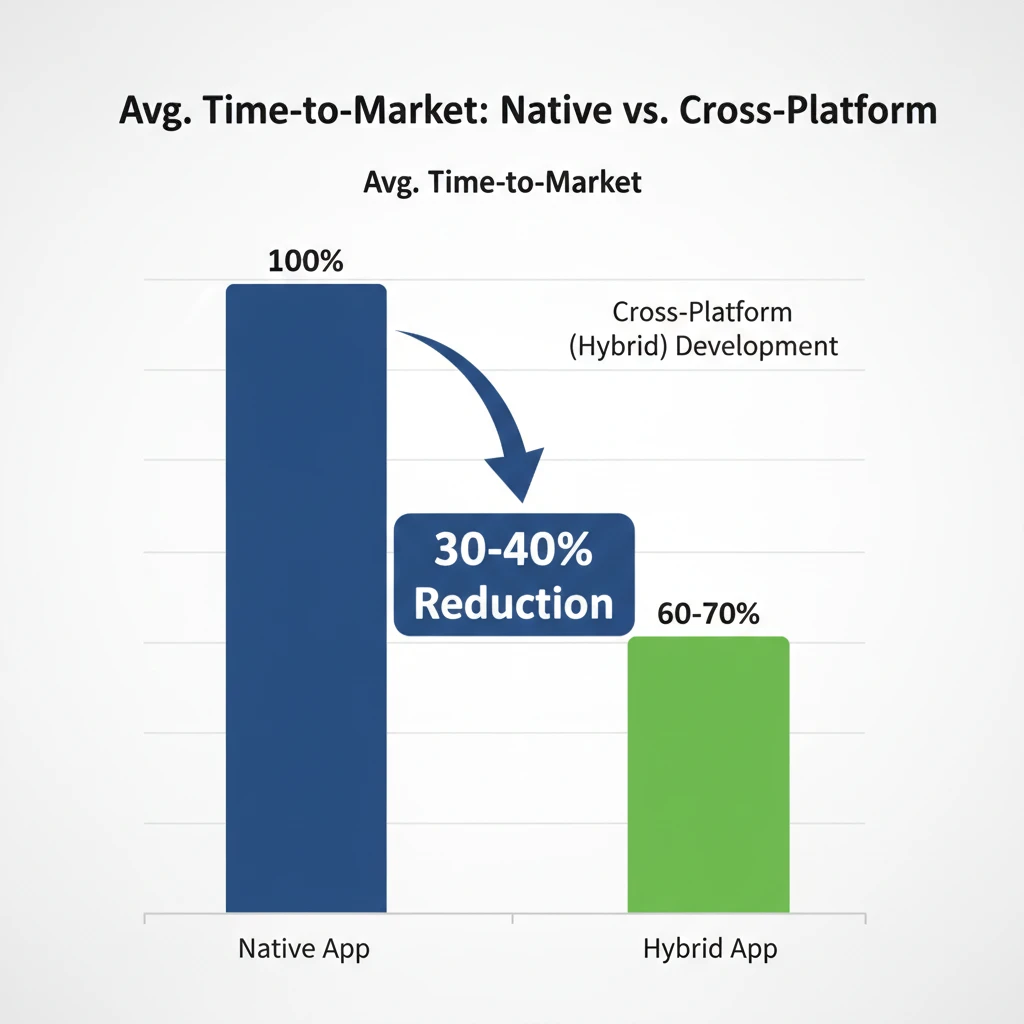
- Cost Efficiency: Cross-platform development reduces initial engineering costs by ~40%.
- Uniformity: Logic sharing ensures your iOS and Android apps behave identically.
- The «Uncanny Valley» is Gone: With advances like Flutter’s Impeller engine and React Native’s New Architecture (Fabric), 99% of users cannot distinguish a hybrid app from a native one.
Top Hybrid Frameworks Ranked (Performance & Talent Availability)
We analyzed market demand, GitHub activity, and our own hiring data at Mindtech to rank these frameworks.
1. Flutter (Google) – The Performance King
Flutter remains the gold standard for startups needing pixel-perfect UI. Unlike other frameworks that rely on OEM widgets, Flutter renders its own pixels using the Skia (and now Impeller) engine.
- Pros: 60FPS consistent performance, «Hot Reload» for rapid dev cycles, strong Google backing.
- Cons: Dart language curve (smaller talent pool than JavaScript), larger app size.
- Best For: Brand-heavy apps where custom UI/UX is the differentiator.
2. React Native (Meta) – The JavaScript Powerhouse
If your team already knows React/Web, this is the logical choice. React Native (RN) maps to native UI components, giving it a truly «native» feel.
- Pros: Massive ecosystem (NPM), huge talent pool, mature «Over-the-Air» (OTA) updates (CodePush).
- Cons: Debugging can be tricky when the bridge between JS and Native breaks.
- Best For: Teams with existing web developers; apps that rely heavily on platform-specific UI patterns.
3. Kotlin Multiplatform (KMP) – The Logic-Sharing Specialist
KMP is the rising star for 2026. Unlike Flutter or RN, KMP allows you to share business logic while keeping the UI 100% native.
- Pros: Zero performance penalty on UI, seamless integration with existing Android apps.
- Cons: Requires writing UI code twice (SwiftUI/Jetpack Compose), steeper learning curve.
- Best For: Scale-ups migrating from native; complex apps with heavy algorithmic logic.
4. .NET MAUI – The Enterprise Choice
The evolution of Xamarin. If your backend is Microsoft/Azure heavy, MAUI integrates perfectly with the .NET ecosystem.
- Pros: Single project structure for iOS, Android, macOS, and Windows; enterprise-grade security support.
- Cons: Slower build times, smaller community compared to JS/Dart.
- Best For: B2B enterprise apps, internal corporate tools.
5. Ionic – The Web-First Approach
Ionic isn’t technically «native» rendering; it uses WebViews (Capacitor). However, for simple CRUD apps, it is unbeatable in speed.
- Pros: Write once using standard Web Tech (HTML/CSS/JS), deploy everywhere (Web/Mobile/PWA).
- Cons: Performance lags on complex animations or heavy data processing.
- Best For: Simple internal tools, rapid MVPs, migrating legacy web apps to mobile.
Comparison Table: Performance vs. Dev Cost vs. Hiring Difficulty
Understanding the tech is easy; finding the team is hard. Here is how they stack up in the current US market:
| Framework | Core Language | Performance Score | US Hiring Difficulty | Dev Cost (Relative) |
| Flutter | Dart | High (9.5/10) | Moderate | Medium |
| React Native | JavaScript/TS | High (9/10) | Low (High supply) | Low |
| KMP | Kotlin | Native (10/10) | High (Niche) | High |
| .NET MAUI | C# | Medium (7/10) | Moderate | Medium |
| Ionic | JS/TS | Low (6/10) | Low | Very Low |
The «Talent Crunch»: Staff Augmentation for Hybrid Teams
Choosing the framework is only Step 1. The biggest hurdle US companies face in 2026 is the cost of senior talent. A Senior Flutter Engineer in San Francisco or NYC commands $160k – $200k/year.
This is where Staff Augmentation shifts from a «cost-saving» tactic to a strategic advantage.
Why Nearshore?
Working with partners in LATAM (Latin America) allows US companies to:
- Cut Costs, Not Quality: Access Senior engineers at 40-50% lower total cost than US hires.
- Time Zone Alignment: Real-time collaboration (EST/CST/PST) ensures agile sprints actually work (unlike offshoring to Asia).
- Cultural Affinity: Engineers who speak fluent English and understand US business culture.
At Mindtech, we specialize in deploying senior squads for React Native and Flutter. Whether you need a full team to build an MVP or two senior devs to augment your core team, the flexibility of staff augmentation reduces the risk of long-term bad hires.
Struggling to find Senior React Native devs? Get 3 pre-vetted profiles in your inbox within 48 hours. Contact Mindtech.
Critical Decision Matrix: Which one should you choose?
- Choose Flutter if: You want a custom, brand-unique design and high performance, and you are willing to learn Dart.
- Choose React Native if: You have web developers on staff and want to move fast with the largest open-source ecosystem.
- Choose KMP if: You already have a native Android app and want to start sharing logic with iOS without rewriting the UI.
- Choose Mindtech if: You know what to build but lack the senior engineering bandwidth to execute it before your deadline.
FAQ: Questions We Get Asked at Mindtech
Is Flutter better than React Native in 2026?
«Better» is subjective. Flutter wins on rendering performance consistency. React Native wins on hiring ease and code reusability with the web.
Can I migrate a hybrid app to native later?
Technically yes, but it is rarely necessary. Companies like Airbnb and Shopify have experimented with this, but for 95% of businesses, a well-architected hybrid app scales indefinitely.
Does hybrid development support AI features?
Absolutely. At Mindtech, we integrate AI models (like Computer Vision or NLP) into hybrid apps via cloud APIs or on-device TensorFlow Lite, seamlessly bridging the gap between native hardware and AI logic.
Conclusion
The technology is ready. The frameworks are mature. The success of your mobile product in 2026 depends on execution.
Don’t let a talent shortage slow down your roadmap. Whether you choose Flutter, React Native, or KMP, ensure you have the right team to build a scalable architecture from Day 1.
Ready to scale your engineering team?
Contact Mindtech to discuss your project and meet our Senior Nearshore Engineers today.


