Forward Deployed Engineer: the role that brings AI into production
The name Forward Deployed Engineer, or FDE, is starting to show up more and more in searches related to artificial intelligence.
It sounds like a new role, though it actually has history. Palantir claims credit for developing this model: engineers who work directly with clients, understand complex problems, and build solutions within the real context of each organization. The company still describes the FDE as someone who combines code, architecture, data, and direct contact with technical and executive stakeholders.
What’s new is the speed at which other tech companies are adopting the concept.
OpenAI, Scale AI, Encord, and various companies focused on autonomous systems are already posting positions with this title. The Financial Times reported that FDE job postings grew more than 800% between January and September 2025.
The explanation makes a lot of sense: developing an AI model is only part of the challenge. Getting it to work reliably every day inside a company — connected to data, tools, permissions, processes, and people — requires a different kind of profile.
That’s where the Forward Deployed Engineer comes in.
What does an FDE do?
An FDE works at the border between the tech product and the client’s operations.
They can be involved from the very first conversation about the problem all the way through final implementation. In a single initiative, they might survey a process, define technical scope, design an architecture, code an integration, build evaluations, deploy the system, and support its adoption.
OpenAI’s current job description sums up the scope pretty well: its FDEs lead full implementations of frontier models, from discovery and design through deployment to production. The company also measures success by real adoption, impact on workflows, and feedback that later shapes product and model roadmaps.
In practice, an FDE might:
- talk with users, leaders, and technical teams,
- understand how a process actually works,
- identify where technology can create value,
- connect with APIs, databases, and internal tools,
- build custom applications or integrations,
- define evaluations to confirm the solution works,
- implement security and governance controls,
- deploy the system to production,
- support the change in habits needed for adoption,
- bring learnings from the client back to the product team.
Scale AI, for example, uses FDEs to build client-specific infrastructure and solve complex data problems for AI. Encord brings them in to lead deployments, develop integrations, and feed the roadmap with learnings gathered during implementation.
The FDE keeps a responsibility that many implementation roles lose: they write production code and are accountable for the outcome.
From demo to real work
Much of the conversation around AI is still focused on model capabilities.
But a controlled demo has few of the constraints that show up inside an organization:
- incomplete or fragmented data,
- legacy systems,
- poorly documented processes,
- permissions and security policies,
- regulations,
- human decisions that are hard to standardize,
- resistance to change,
- tools that don’t integrate with each other.
- A solution can work really well during a trial and fail once it has to run with thousands of users, sensitive information, exceptions, and internal dependencies.
The FDE works across that gap.
Their job is to understand the client’s real conditions and turn a general technological capability into a system that can be used reliably.
This need is pushing the sector’s leading companies to invest in deployment, in addition to research and product.
In May 2026, OpenAI announced the creation of a dedicated company to help organizations implement AI within their operations. The initiative began with an agreement to bring on roughly 150 Forward Deployed Engineers and deployment specialists from Tomoro, and it was launched with more than $4 billion in initial investment.
A few weeks later, AWS announced a Forward Deployed Engineering organization backed by $1 billion in investment, aimed at embedding thousands of engineers alongside clients to build agentic AI systems in production.
These are strong signals of the same trend: the bottleneck is shifting from access to models toward the ability to implement them with real impact.
A profile that’s hard to pigeonhole
The FDE combines capabilities that are normally spread across several positions.
It requires engineering depth to build and deploy. It also requires product judgment to decide what’s worth building. It calls for an understanding of business processes, the ability to communicate with stakeholders, and comfort operating autonomously in ambiguous environments.
Depending on the company, it can look like a mix of:
- software engineer,
- solutions architect,
- implementation engineer,
- technical product manager,
- technology consultant,
- customer engineer.
- The difference lies in the level of ownership.
The job doesn’t end with a recommendation, an architecture, or a demo. The FDE stays with the system until it’s actually working within the operation.
That’s why the position is especially valuable at AI companies. Models change fast, their outputs aren’t always deterministic, and every implementation needs its own evaluations. The person needs to understand both the technology and the process they’re trying to improve.
What skills does it require?
Looking at current job postings, four broad skill groups stand out.
1. Technical depth
Depending on the product and industry, this can include:
- Python, JavaScript, or TypeScript,
- backend or full-stack development,
- APIs and integrations,
- cloud and infrastructure,
- data pipelines,
- security and permissions,
- distributed systems,
- LLMs, agents, and generative models,
- evaluations, observability, and monitoring.
- OpenAI, for example, looks for experience building production systems, working with generative models, and writing both frontend and backend code.
2. Diagnostic ability
The client doesn’t always know exactly what they need.
They might ask for a chatbot when their real problem is data quality. They might want to automate a step that should actually be eliminated. They might picture a sophisticated solution for a process that doesn’t even have clear criteria yet.
The FDE needs to ask good questions, observe workflows, and translate a vague need into a problem that can actually be solved.
3. Stakeholder management
The role involves conversations with developers, users, legal, security, leadership, and sales teams.
Each of them speaks a different language and measures success differently. The FDE has to explain complexity without hiding it and hold agreements together among people with different priorities.
4. Results orientation
Implementations move forward under uncertainty.
The FDE needs to make calls on scope, speed, and quality, spot risks, remove blockers, and build a first version without losing sight of future operations.
The ability to deliver matters just as much as code quality.
The challenge for Recruiting
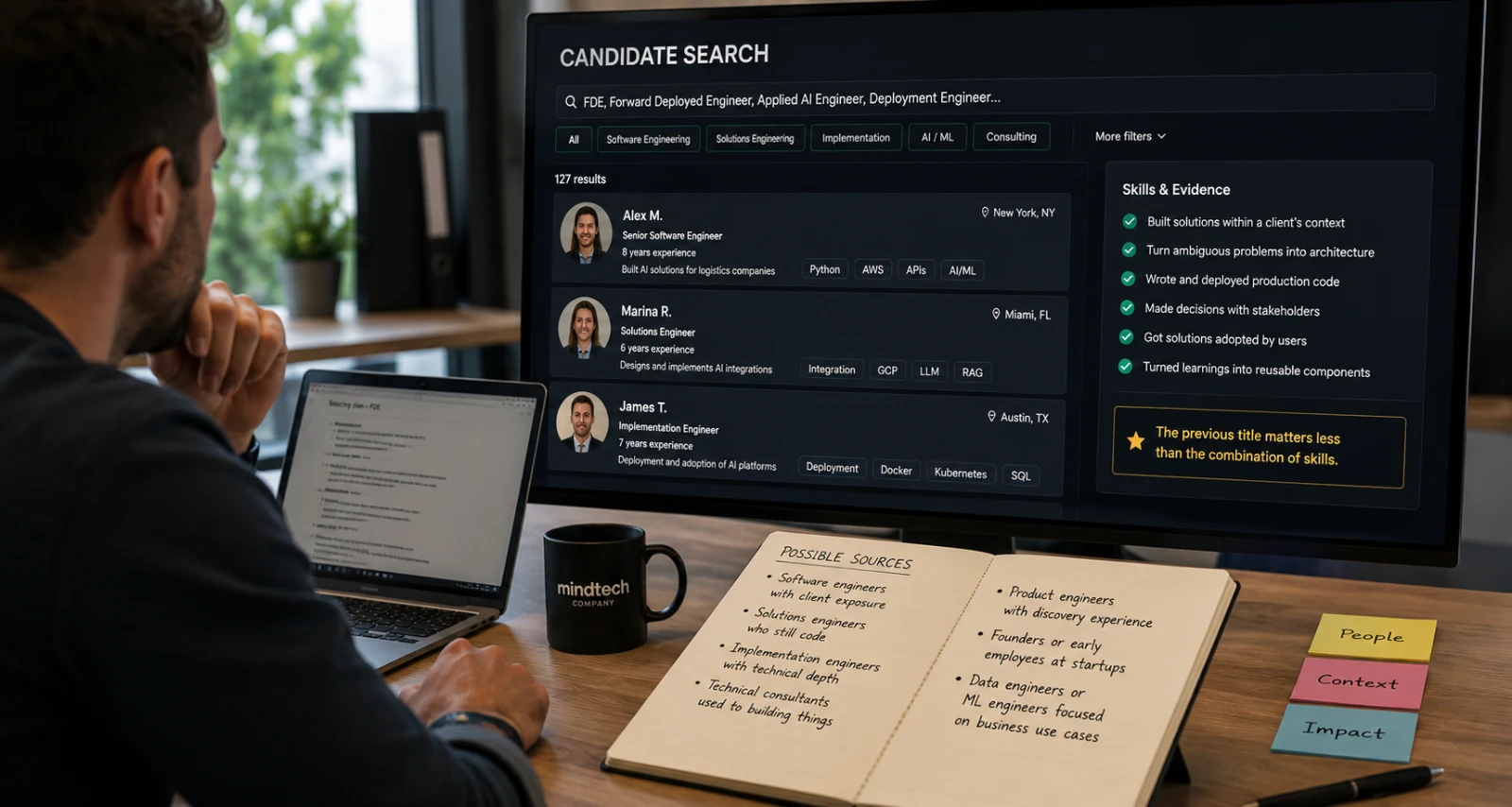
For Recruiting, the first problem will be searching for the title too literally.
There’s still no standard definition. Some companies say Forward Deployed Engineer, others use names like Applied AI Engineer, Deployment Engineer, Customer Engineer, Solutions Engineer, or Applied AI Architect for similar jobs.
Limiting sourcing to candidates who already have «FDE» on LinkedIn can rule out relevant profiles.
Possible sources include:
- software engineers with client exposure,
- solutions engineers who still code,
- implementation engineers with strong technical depth,
- technical consultants used to building things,
- product engineers with discovery experience,
- founders or early employees at startups,
- data engineers or ML engineers focused on business use cases.
- The search needs to prioritize evidence of behavior:
Did they build solutions within a client’s context? Can they turn an ambiguous problem into an architecture? Did they write and deploy production code? Did they make decisions in front of stakeholders with conflicting interests? Did they get a solution actually adopted? Did they turn specific learnings into reusable components?
The previous title matters less than the combination of skills.
How to evaluate an FDE
A traditional technical interview will only cover part of it.
The process should look at at least six dimensions:
- Engineering: ability to build reliable systems.
- Diagnosis: quality of the questions asked before proposing anything.
- Architecture: ability to design under real-world constraints.
- Communication: clarity with both technical and business audiences.
- Delivery: ownership from problem to production.
- Product judgment: ability to separate a specific need from a reusable pattern.
- A practical case can be more informative than a series of abstract questions.
For example:
A client wants to automate an approval process with an agent. The data is spread across three systems, there are undocumented exceptions, and the security team won’t allow sensitive information to be sent to external services. How would you approach the project?
What matters isn’t whether the candidate reaches a solution quickly.
Worth observing:
- what they ask first,
- what assumptions they identify,
- how they prioritize,
- what risks they anticipate,
- what they’d build in a first version,
- how they’d validate results,
- what they’d keep under human control,
- how they’d explain the plan to the client.
- The FDE needs to be just as comfortable in front of a terminal as in front of an executive conversation.
The risk of becoming a custom-solution factory
The model also creates tensions.
If every client gets a completely different build, the company can end up operating like a consulting firm with costs that are hard to scale.
The FDE has to solve the specific problem while also recognizing which learnings can be turned into product, components, playbooks, or reusable integrations.
OpenAI explicitly includes among the role’s responsibilities the codification of work patterns into tools and building blocks others can reuse, along with feeding field feedback back to Product and Research. (OpenAI)
That loop is one of the model’s biggest contributions:
client → implementation → learning → product → new implementation
When it works, each project helps improve the next one.
A role for a new stage of AI
The Forward Deployed Engineer reflects a shift in the market.
During the first stage of generative AI, much of the value was tied to accessing better models and experimenting with their capabilities.
The next stage will be more about implementation:
- which processes are worth redesigning,
- how to connect AI with data and tools,
- how to evaluate results,
- how to operate securely,
- how to drive adoption,
- how to turn specific learnings into scalable capabilities.
- The FDE shows up exactly at that point.
There will still be significant variation between companies. In some it will be primarily a technical role. In others it will have a strong consultative dimension. Some will place it within Engineering, others near Product, Professional Services, or Go-to-Market.
But the pattern is already visible: companies need engineers capable of getting close to the problem, building under real conditions, and taking ownership of the final impact.
For Recruiting, the opportunity is to learn how to recognize these people before the title fully settles into place.
Because many of the future Forward Deployed Engineers are probably already working.
They just still go by another name.
Sources consulted
- Palantir, current Forward Deployed Software Engineer role description. (Lever)
- OpenAI, Forward Deployed Engineer job description. (OpenAI)
- OpenAI, announcement of the OpenAI Deployment Company. (OpenAI)
- AWS, launch of Forward Deployed Engineering for customers and partners. (Amazon Web Services, Inc.)
- Scale AI, Forward Deployed Engineer, GenAI. (Scale AI)
- Financial Times, analysis on the growth of the role at AI companies. (Financial Times)