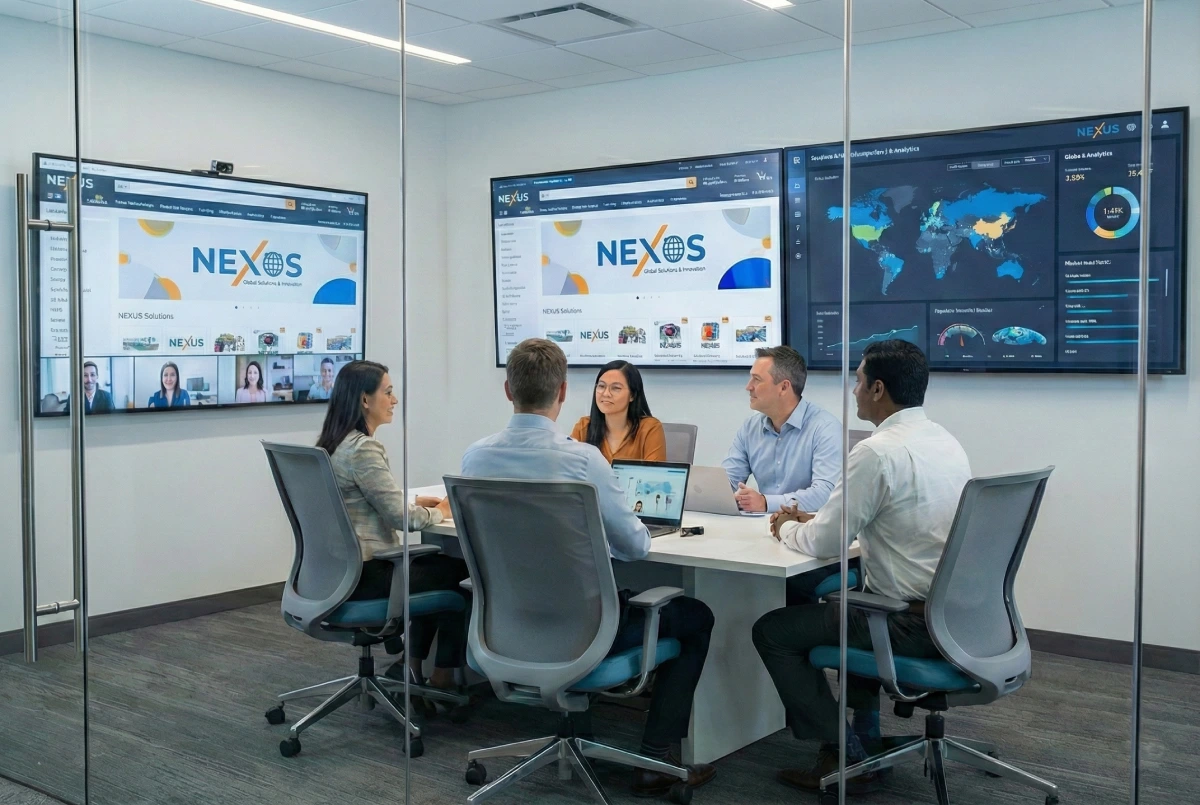
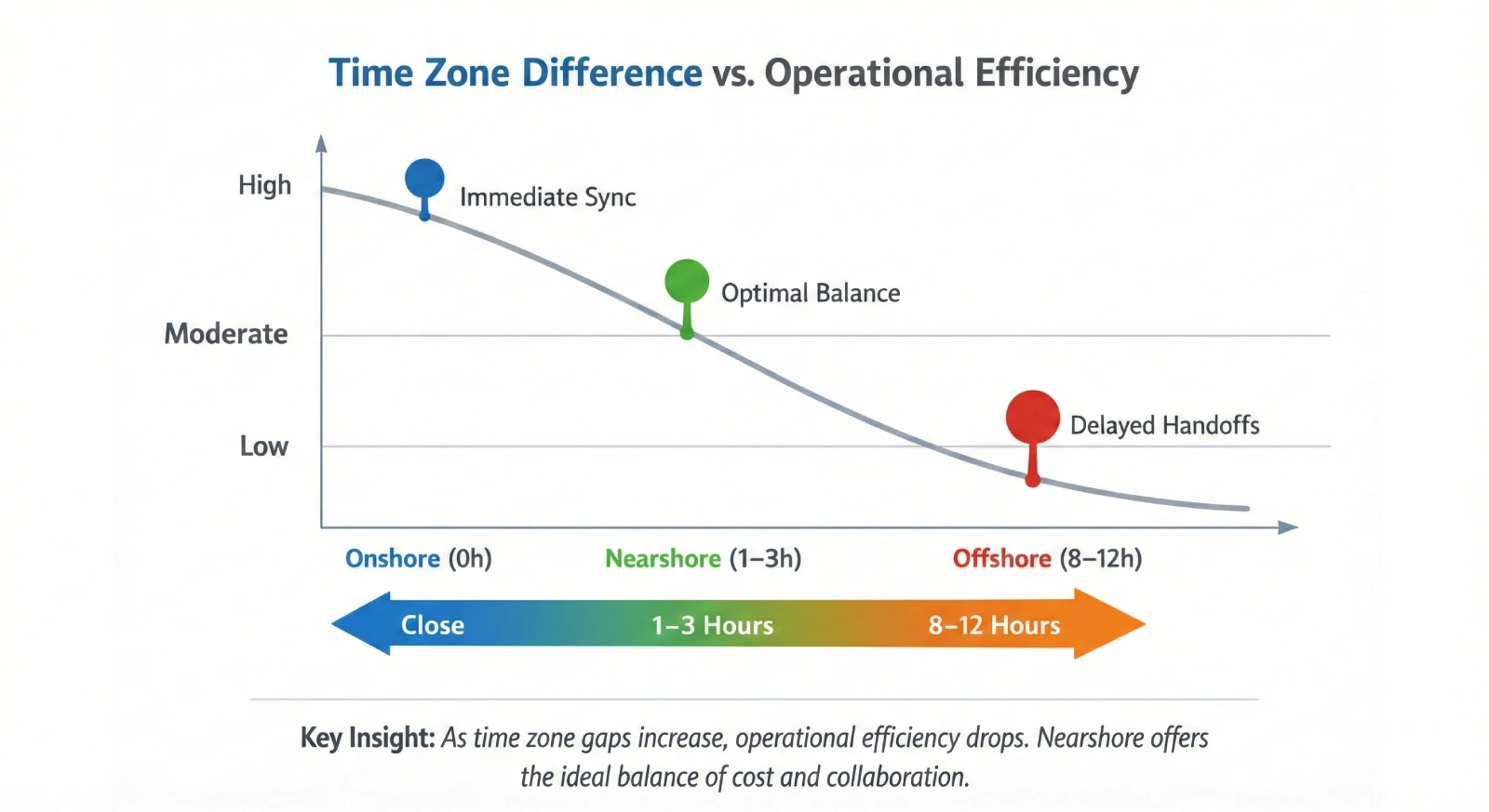
The nearshore outsourcing model is a strategy where US companies outsource software development to nearby countries within a 1–3 hour time zone difference. Compared to offshore outsourcing, nearshore enables real-time collaboration, faster decision-making, and lower operational friction—delivering strong cost efficiency without sacrificing speed, control, or engineering quality.
How the Nearshore Software Development Model Actually Works
The nearshore software development model works when external engineers don’t feel “external.” The goal isn’t outsourcing tasks—it’s extending your engineering organization with teams that operate inside your processes, time zones, and delivery standards.
Below is how this looks in practice.
Team Integration Models (Staff Augmentation vs. Dedicated Squads)
Nearshore typically operates under two proven integration models. Choosing the right one depends on how much ownership and velocity you need.
- Nearshore engineers join your existing teams
- You retain full technical leadership and roadmap control
- Ideal for filling skill gaps or accelerating delivery short-term
- Cross-functional nearshore teams (backend, frontend, QA, DevOps)
- Managed under shared KPIs and delivery goals
- Best for product teams that need sustained velocity and scale
Agile Execution & Time-Zone Alignment (Day-to-Day Reality)
This is where nearshore fundamentally outperforms offshore.
Real example — Daily stand-up: NYC ↔ Medellín
- 9:30 AM EST: Joint stand-up with product, QA, and engineering
- Same-day feedback on blockers or scope changes
- No overnight delays, no asynchronous guesswork
What this enables:
- Faster sprint cycles
- Immediate decision-making
- Fewer misunderstandings and less rework
Nearshore removes the “24-hour lag” that quietly kills velocity in offshore models—this is one of the biggest hidden productivity gains.
Communication Stack & Governance
Control is a top concern for any CTO. Nearshore models succeed when communication and governance are structured—not improvised.
Typical stack:
- Slack / Microsoft Teams for real-time collaboration
- Jira or Azure DevOps for backlog, sprint tracking, and visibility
- Daily stand-ups + weekly sprint reviews
- Clear ownership: tech leads, delivery managers, and escalation paths
Why this matters:
- Full transparency on progress and risks
- Predictable delivery
- Shared accountability across onshore and nearshore teams
You’re not managing a vendor—you’re managing an extension of your engineering org.
Nearshore vs. Offshore vs. Onshore — The Strategic Choice
When US tech leaders compare delivery models, the real question isn’t “Which is cheaper per hour?”
It’s “Which model delivers faster, with less friction, and lower total risk?”
This comparison focuses on operational reality, not theoretical pricing.
High-Impact Comparison Table
| Decision Factor | Onshore (US) | Nearshore (LATAM) | Offshore (Asia / E. Europe) |
| Cost Structure (Real vs Theoretical) | Highest hourly cost | 30–50% lower than US | Lowest hourly rate |
| Time-Zone Overlap | Full overlap | 6–8 hours overlap | Minimal or none |
| Cultural Alignment | Very high | High (work style & communication) | Variable |
| Communication Latency | None | Minimal | High (async dependency) |
| Travel & Site Visits | Easy | Short, affordable flights | Costly and time-consuming |
| Total Cost of Outsourcing (TCO) | High | Optimized | Often higher than expected |
What the Table Really Tells You
- Onshore delivers maximum control—but at a premium that limits scale.
- Offshore reduces hourly rates, but introduces delays, handoffs, and rework.
- Nearshore sits in the middle on paper—and wins in execution.
Nearshore balances cost efficiency with real-time collaboration, which is critical for agile teams shipping fast.
Key Nearshore Outsourcing Advantages for US Tech Companies
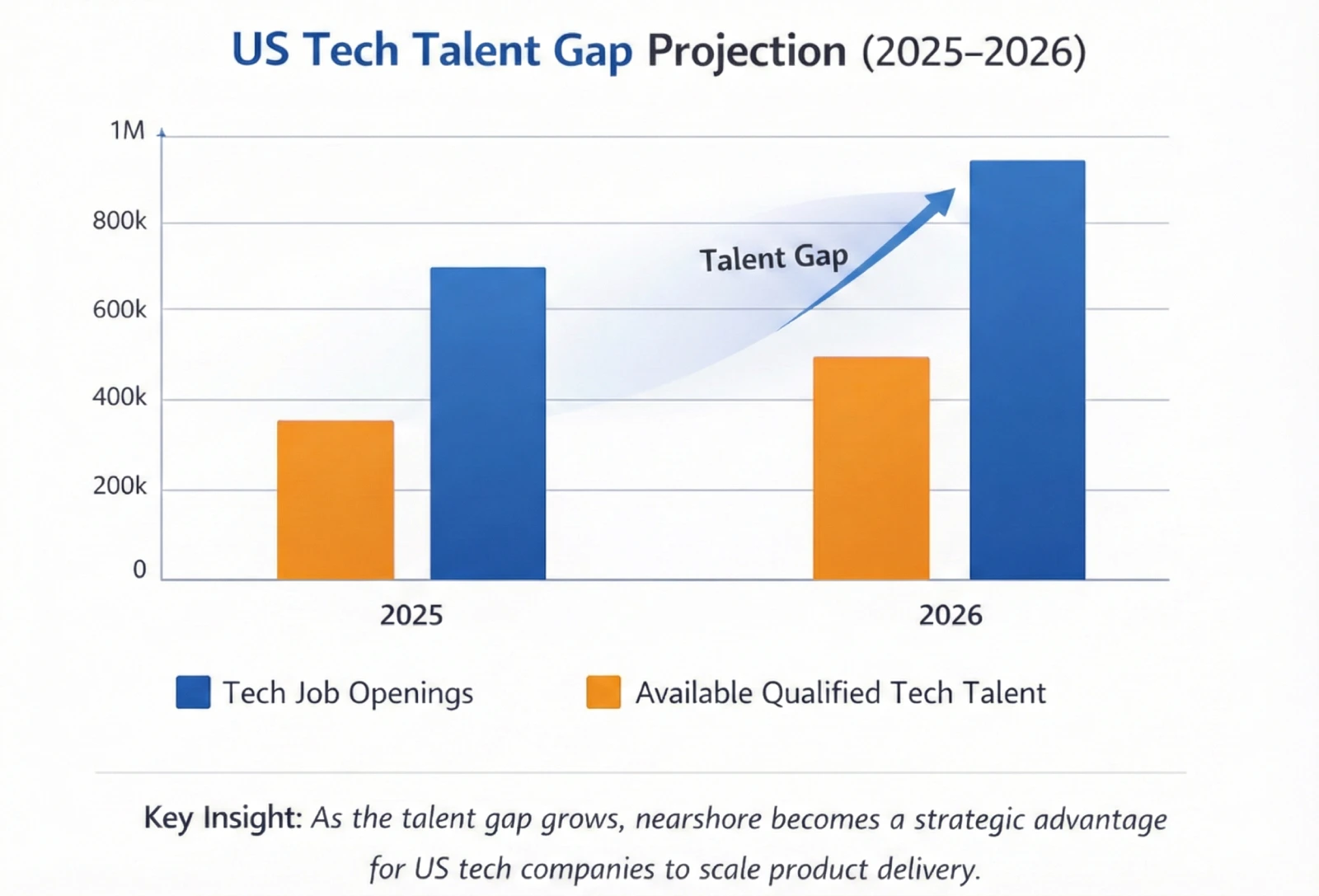
Nearshore outsourcing isn’t just a cost play. For US tech companies under pressure to ship faster and scale responsibly, it’s a strategic operating model that improves speed, access to talent, and financial efficiency at the same time.
These are the advantages that actually move the needle.
Real-Time Collaboration & Faster Agile Cycles
One of the biggest advantages of nearshore is the elimination of response lag.
When teams work in overlapping time zones:
- Questions are resolved the same day—not the next sprint
- Product feedback loops stay tight
- Decisions don’t stall waiting for async handoffs
What this changes operationally:
- Higher sprint velocity
- Fewer blockers carried over
- More predictable release cycles
For agile teams, nearshore restores the cadence that offshore models often break.
Access to Top-Tier Talent in Emerging LATAM Tech Hubs
Nearshore opens access to highly skilled engineers in mature and fast-growing tech ecosystems across Latin America—particularly in countries like Colombia, Mexico, Argentina, and Uruguay.
What matters here isn’t volume, but quality and alignment:
- Strong engineering fundamentals
- Experience working with US-based product teams
- Cultural compatibility with agile, outcome-driven environments
This gives US companies access to senior-level talent without competing head-to-head in an overheated local hiring market.
30–50% Cost Savings Without Sacrificing Code Quality
From an engineering economics perspective, nearshore delivers meaningful savings—typically 30–50% compared to US-based hiring—without lowering technical standards.
Why this resonates at board level:
- Lower cost per productive sprint
- Reduced attrition vs local hiring churn
- Better ROI than offshore once velocity and rework are considered
Nearshore optimizes cost per outcome, not just cost per hour.
Overcoming Barriers: Security, IP, and Communication
For most US tech leaders, the decision to outsource isn’t blocked by cost—it’s blocked by risk.
Nearshore models work when security, IP, and communication are engineered into the operating model from day one.
Here’s how those barriers are addressed in practice.
Security & Compliance (SOC 2, GDPR, Secure SDLC)
A mature nearshore setup aligns with the same security expectations as US-based teams.
What to expect at minimum:
- SOC 2–aligned processes (access control, logging, incident response)
- GDPR-aware data handling for products with EU exposure
- Secure SDLC practices embedded in the delivery pipeline
Operationally, this means:
- Role-based access to code and infrastructure
- Secure VPNs and device management
- Auditable workflows across development and deployment
Security isn’t a checkbox—it’s a continuous process that must be enforced across both onshore and nearshore teams.
Intellectual Property Protection & Legal Frameworks
IP risk is often overestimated when the legal structure is unclear—and underestimated when it’s ignored.
In a proper nearshore model:
- Contracts clearly define code ownership from day one
- IP is assigned to the US parent entity
- Jurisdictions are chosen for enforceability and legal compatibility
Most US companies operate under US-governed contracts, even when teams are based abroad, ensuring alignment with board and investor expectations.
English Proficiency & Cultural Alignment
Communication failures rarely come from tools—they come from language and context gaps.
Nearshore teams typically operate with:
- English proficiency at B2/C1 level
- Experience collaborating with US-based product and engineering teams
- Familiarity with agile ceremonies and product discovery workflows
Why this matters:
- Fewer misunderstandings in requirements
- Faster alignment during backlog grooming and discovery
- Less friction between product, design, and engineering
Strong language skills and cultural alignment directly reduce delivery risk.
Checklist — How to Choose the Right Nearshore Partner
At this stage, the question isn’t if nearshore works—it’s who you trust to execute it. Use this checklist to separate true delivery partners from staffing vendors.
✅ Vetting Process & Seniority Mix
A strong nearshore partner doesn’t just “provide engineers”—they prove capability.
What to validate:
- Structured technical interviews and coding assessments
- Clear seniority mix (senior, mid, tech leads)
- Engineers with real production experience, not bench profiles
Red flag: No visibility into how engineers are evaluated or selected.
✅ Scalability (Scale Up / Scale Down)
Your product roadmap will change. Your team must adapt without friction.
Look for:
- Ability to add or reduce engineers within weeks—not months
- No long-term lock-ins that limit flexibility
- Experience scaling teams during growth or market shifts
Nearshore should increase agility, not create new constraints.
✅ Industry Expertise (SaaS, FinTech, Healthcare)
Context matters as much as code.
A reliable partner understands:
- SaaS delivery models and recurring release cycles
- FinTech compliance and security expectations
- Healthcare data sensitivity and regulated environments
This reduces onboarding time and lowers execution risk.
✅ Delivery Governance & KPIs
Execution without governance leads to surprises.
Ensure the partner operates with:
- Defined KPIs (velocity, quality, predictability)
- Regular reporting and delivery reviews
- Clear escalation paths and ownership
You should always know where the project stands—and why.
✅ Security & IP Readiness
Security and IP protection must be built-in, not negotiated later.
Confirm:
- SOC 2–aligned practices
- Secure access control and SDLC processes
- Contracts that clearly assign IP ownership to your company
If this isn’t clear upfront, it becomes a risk later.
This checklist is designed to support confident decision-making, not rushed outsourcing.
Frequently Asked Questions About the Nearshore Outsourcing Model
What is the best country for nearshore outsourcing in 2026?
There is no single “best” country. Top nearshore locations in 2026 combine strong engineering talent, time-zone alignment with the US, and legal stability. Countries like Colombia, Mexico, Argentina, and Uruguay stand out due to mature tech ecosystems and experience working with US-based product teams.
Is nearshore more expensive than offshore?
On an hourly basis, nearshore can cost more than offshore. However, when factoring in delivery speed, reduced rework, and real-time collaboration, nearshore often delivers a lower Total Cost of Outsourcing (TCO). Faster cycles and fewer delays typically offset the higher hourly rate.
How do you manage IP protection in a nearshore model?
IP protection is managed through US-governed contracts, clear ownership clauses, and secure development practices. Code ownership is assigned to the client from day one, supported by access controls, secure repositories, and auditable workflows aligned with standard compliance frameworks.
What are the main risks of the nearshore outsourcing model?
The main risks include weak governance, unclear ownership structures, and poor partner selection. These risks are mitigated through proper vetting, defined KPIs, strong security practices, and clear communication models. Nearshore itself is not the risk—poor execution is.
Conclusion: Why the Nearshore Outsourcing Model Is a Strategic Advantage
For US tech leaders under pressure to scale faster without losing control, the nearshore outsourcing model offers a pragmatic balance between speed, quality, and cost. It reduces delivery friction, improves collaboration, and optimizes engineering economics—without the risks typically associated with offshore outsourcing. When executed correctly, nearshore becomes a long-term growth enabler, not just a staffing solution.