
When businesses explore nearshore outsourcing, the most pressing question isn’t what it is, but who has successfully done it and why it worked. Real nearshore outsourcing examples include universities in Latin America that scaled their digital capabilities through close collaboration with remote teams, retail giants like Falabella that accelerated digital operations without adding internal headcount, and global automotive companies that improved decision-making and customer experience by leveraging nearshore experts.
These successes share a common thread: they focus on business outcomes, seamless collaboration, and strategic alignment, proving that nearshore teams can deliver measurable value beyond cost savings while reducing risk for companies ready to scale.
Why Nearshore Outsourcing Examples Matter for Business Leaders
For executives and business leaders, understanding the concept of nearshore outsourcing is one thing—but seeing it applied successfully is another. Real-world examples provide proof that the model works, reducing uncertainty and helping decision-makers feel confident in taking action.
By analyzing how companies in different industries have leveraged nearshore teams, leaders can see patterns, anticipate challenges, and make informed choices without being the first to experiment.
From Understanding Nearshore to Seeing It Work in Practice
Knowing the theory behind nearshore outsourcing is helpful, but it doesn’t answer the critical question: will it deliver results for my business? Examining concrete examples shows how companies navigate time zones, cultural alignment, and team integration. These real cases demonstrate that when nearshore teams are treated as strategic partners, not just vendors, businesses achieve outcomes efficiently and reliably.
Examples reduce risk because they reveal what has worked before, providing a blueprint that leaders can adapt to their own needs.
What Decision-Makers Look for in a Nearshore Outsourcing Example
When evaluating nearshore outsourcing opportunities, executives focus on four key elements:
- Context: Understanding the industry, business challenges, and scale of the project.
- Approach: How the nearshore team was integrated, managed, and aligned with company goals.
- Business Outcomes: Concrete benefits, such as improved efficiency, faster delivery, or enhanced customer experience.
- Lessons Learned: Insights into what made the collaboration successful, and how those strategies can be applied elsewhere.
By reviewing these aspects in each example, business leaders gain confidence and clarity, seeing not only what was done but how it produced results—making nearshore outsourcing a strategic, low-risk option for growth.
What Defines a Successful Nearshore Outsourcing Example?
Not all nearshore outsourcing arrangements deliver the same results. The difference between a project that drives measurable business value and one that falls short often comes down to how it is structured, managed, and aligned with company goals. By examining successful examples, we can identify key principles that make nearshore outsourcing a reliable strategy for growth and innovation.
Clear Business Goals Before Execution
A successful nearshore outsourcing initiative starts with clearly defined business objectives. Companies that articulate what they want to achieve—whether it’s accelerating product delivery, improving operational efficiency, or enhancing customer experience—set the stage for measurable results.
Clear goals guide the team, align expectations, and provide a benchmark for success, ensuring that every effort contributes to meaningful business outcomes.
Nearshore Teams Working as an Extension of the Company
The most effective nearshore teams are treated as partners, not just vendors. When teams are integrated into the company’s culture, processes, and workflows, they operate seamlessly alongside internal staff.
This approach fosters ownership, accountability, and a deeper understanding of business priorities, turning nearshore collaboration into a strategic advantage rather than a simple outsourcing arrangement.
Continuous Collaboration Across Time Zones
Time zone differences can be a challenge—or an advantage—depending on how they are managed. Successful companies implement structured communication routines, overlapping work hours, and transparent project management.
Continuous collaboration ensures that progress is steady, issues are addressed promptly, and teams remain aligned. Effective communication transforms nearshore teams into a cohesive extension of the organization, even across continents.
Focus on Outcomes, Not Just Cost Reduction
While nearshore outsourcing can offer cost benefits, the companies that see lasting success focus on business outcomes first. Whether it’s faster time-to-market, higher product quality, or improved customer satisfaction, outcome-driven initiatives create tangible value that justifies the investment.
By prioritizing results over purely financial metrics, businesses unlock the full potential of nearshore partnerships and build a foundation for sustainable growth.
Nearshore Outsourcing Examples Explained Through Real Success Stories
Not all nearshore outsourcing stories are created equal. In this section, we focus on real success stories, not just lists, analyzing how companies in different industries have leveraged nearshore teams to achieve measurable business outcomes.
Each example highlights the challenge faced, the collaboration model used, the impact delivered, and why it succeeded, providing a blueprint that executives can learn from.
Example of Nearshore Outsourcing in Education: Universities in Latin America
✅ Business Challenge:
Universities in Latin America faced increasing demand for digital learning solutions while operating with limited internal IT resources. Traditional outsourcing methods had proven slow and inflexible, leaving critical projects behind schedule.
✅ Nearshore Collaboration Model:
By partnering with a nearshore team treated as an extension of their own staff, universities implemented agile workflows, maintained regular communication across time zones, and ensured alignment with institutional goals. The collaboration focused on strategic delivery rather than just completing tasks.
✅ Business Impact:
The nearshore approach enabled faster rollout of digital platforms, improved online student experience, and streamlined administrative operations. Universities were able to innovate without significantly increasing internal headcount or operational risk.
✅ Why It Worked:
Success was driven by clear objectives, close collaboration, and treating the nearshore team as a strategic partner. This example demonstrates how structured nearshore engagement can deliver tangible business outcomes.
Nearshore Outsourcing Example in Retail: Scaling Digital Operations for Large Enterprises
✅ Context:
Retail enterprises like Falabella and other department stores faced pressure to modernize digital operations while keeping costs manageable. Internal teams were stretched thin, and rapid market changes required faster adaptation.
✅ How Nearshore Was Applied:
Nearshore teams were integrated into the retail organizations’ workflows, participating in planning, development, and operational execution. Agile practices, overlapping working hours, and frequent alignment meetings ensured seamless coordination with internal staff.
✅ Organizational Impact:
Companies achieved accelerated product rollouts, improved digital customer experience, and more efficient operations. By leveraging nearshore teams as strategic partners rather than simple contractors, they maintained flexibility while scaling effectively.
✅ Key Success Factors:
- Alignment with business objectives
- Continuous collaboration and open communication
- Focus on delivering outcomes rather than just reducing costs
Nearshore Outsourcing Example in Automotive: Improving Decision-Making at Global Scale
✅ Complex Industry Context:
Global automotive companies deal with massive data volumes, stringent regulations, and highly competitive markets. Internal teams struggled to extract actionable insights efficiently.
✅ Global Coordination:
Nearshore teams were deployed as integrated partners, working across continents to ensure that processes, analysis, and recommendations aligned with corporate strategy. Clear communication and structured workflows allowed for seamless decision-making.
✅ Strategic Outcomes:
Companies improved their operational efficiency, enhanced customer experience, and accelerated data-driven decision-making without expanding internal teams significantly. The collaboration also reduced time-to-market for key initiatives.
✅ Lessons for US Companies:
- Treat nearshore teams as strategic partners
- Focus on business outcomes rather than technical execution
- Maintain continuous alignment and clear goals
Common Patterns Across These Nearshore Outsourcing Examples
Analyzing multiple successful nearshore outsourcing cases reveals common traits that consistently lead to business value. Understanding these patterns helps decision-makers replicate success without relying on industry-specific conditions, making nearshore outsourcing a scalable and reliable strategy.
What These Companies Did Right
✅ Leadership Involvement:
In every successful case, executive leadership was actively engaged. Leaders set clear priorities, provided direction, and maintained oversight, ensuring that nearshore teams understood the company’s strategic objectives.
✅ Clear Expectations:
All parties agreed on objectives, deliverables, and success criteria upfront. This clarity minimized misunderstandings, improved accountability, and aligned efforts toward meaningful business outcomes.
✅ Nearshore as a Strategic Partner:
Rather than treating teams as vendors, these companies integrated nearshore resources into their core operations. Nearshore teams were empowered to make decisions, participate in planning, and contribute ideas, creating a true extension of the company’s workforce.
Why These Nearshore Outsourcing Examples Are Replicable
✅ Not Industry-Dependent:
The principles behind their success—strategic alignment, clear goals, and collaborative engagement—apply across sectors. Whether in education, retail, or automotive, these strategies deliver consistent value.
✅ Dependent on Approach, Not Geography:
Success stems from how nearshore outsourcing is implemented, not where the team is located. Companies that focus on collaboration, communication, and outcome-driven delivery can replicate results regardless of their market or operational environment.
How to Apply These Nearshore Outsourcing Examples to Your Own Company
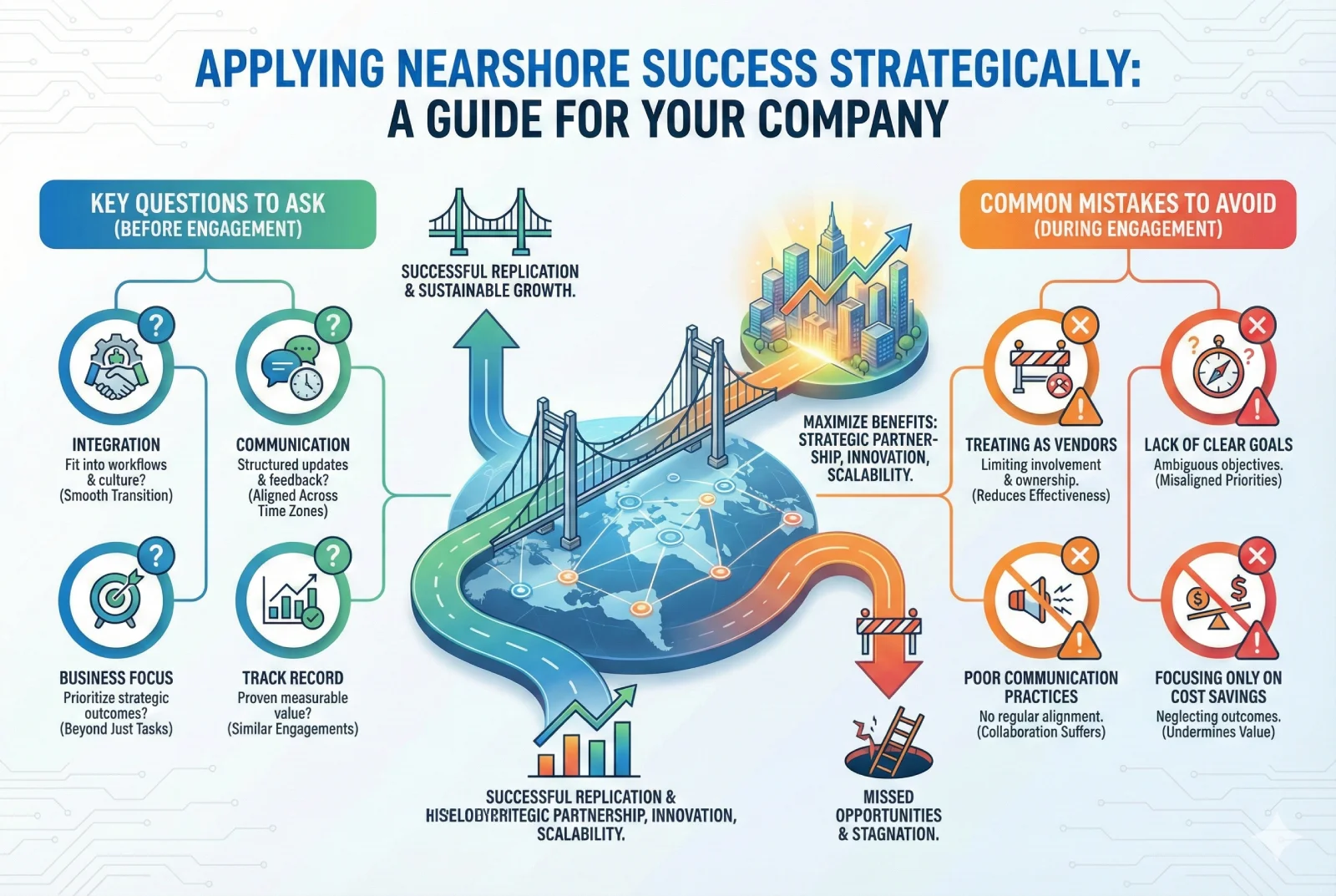
Understanding what makes nearshore outsourcing successful is only the first step. The real value comes from applying these lessons strategically within your own organization. By asking the right questions and avoiding common pitfalls, companies can replicate success while minimizing risk.
Key Questions to Ask Before Choosing a Nearshore Partner
Before engaging a nearshore team, executives should consider the following:
- Integration: How will the nearshore team fit into our existing workflows and culture?
- Communication: Are there structured processes for regular updates, feedback, and alignment across time zones?
- Business Focus: Does the partner understand our strategic objectives and prioritize outcomes over just completing tasks?
- Track Record: Can the partner provide examples of similar engagements where measurable value was delivered?
These questions help decision-makers identify partners who act as strategic extensions of the company rather than just service providers.
Common Mistakes Companies Make When Replicating Nearshore Success
Even with strong examples to follow, some companies stumble by:
- Treating Nearshore Teams as Vendors: Limiting involvement and ownership reduces effectiveness.
- Lack of Clear Goals: Ambiguous objectives lead to misaligned priorities and inconsistent results.
- Poor Communication Practices: Without regular alignment and transparency, collaboration suffers.
- Focusing Only on Cost Savings: Neglecting outcomes undermines the strategic value of the partnership.
By avoiding these pitfalls and applying the proven patterns from successful examples, companies can maximize the benefits of nearshore outsourcing and achieve sustainable growth.
Why Companies Trust Mindtech for Nearshore Outsourcing
When it comes to nearshore outsourcing, companies don’t just look for service providers—they seek trusted partners who can deliver measurable business value. Mindtech has built a reputation for enabling organizations across industries to scale operations, accelerate innovation, and achieve strategic goals with confidence.
✅ Multisector Experience:
Mindtech has collaborated with clients in education, retail, automotive, and more. This breadth of experience allows us to understand unique industry challenges and provide solutions that are both practical and effective.
✅ Consultative Approach:
Every engagement begins with a deep understanding of the client’s objectives. Mindtech works closely with internal teams to ensure alignment, guiding companies through the planning, execution, and optimization of nearshore projects with a strategic mindset.
✅ Nearshore as an Extension of Your Business:
Our teams are fully integrated into client workflows, acting as an extension of your organization rather than an external contractor. This partnership model fosters ownership, accountability, and results that truly matter to the business.
✅ Real Cases, Not Promises:
Mindtech’s approach is grounded in proven outcomes. By analyzing successful nearshore outsourcing examples and tailoring strategies to each client, we deliver solutions that generate tangible value while reducing risk.
Choosing Mindtech means partnering with a nearshore provider that prioritizes alignment, collaboration, and business outcomes, helping your organization achieve growth and efficiency without compromise.
Real Questions Business Leaders Ask About Nearshore Outsourcing
What is an example of nearshore outsourcing?
A nearshore outsourcing example is when a company partners with a remote team in a nearby country to extend its capabilities while maintaining close collaboration and overlapping time zones. For instance, universities in Latin America and retail enterprises like Falabella have successfully used nearshore teams to scale digital operations, improve efficiency, and deliver strategic outcomes without increasing internal headcount.
What is the difference between nearshore and offshore outsourcing?
Nearshore outsourcing involves working with teams in geographically close countries, often sharing similar time zones and cultural affinity, which enables smoother communication and faster collaboration. Offshore outsourcing, on the other hand, usually refers to partners in distant countries with larger time zone differences, which can increase coordination challenges and response times.
Why do US companies choose nearshore outsourcing?
US companies opt for nearshore outsourcing to gain access to specialized talent, scale operations quickly, and maintain closer alignment with internal teams. By partnering with nearby countries, businesses benefit from reduced risk, more transparent communication, and the ability to integrate remote teams as strategic extensions of their workforce.
When does nearshore outsourcing make the most sense?
Nearshore outsourcing makes the most sense when companies need to accelerate projects, access talent that is scarce locally, or expand digital capabilities without the overhead of hiring internally. It is particularly effective for initiatives that require frequent collaboration, fast decision-making, and alignment with strategic business objectives.
How do companies ensure nearshore outsourcing success?
Success is achieved by treating nearshore teams as partners rather than vendors, setting clear objectives, and maintaining continuous communication. Companies that prioritize business outcomes, establish structured workflows, and involve leadership in oversight consistently see better results and can replicate success across multiple projects and industries.
Final Thoughts: Why Nearshore Outsourcing Examples Build Confidence to Scale
Nearshore outsourcing examples provide more than just proof—they offer confidence for leaders to scale with reduced risk. By seeing how universities, retail giants, and global automotive companies have successfully leveraged nearshore teams, executives gain clarity on what works, what to avoid, and how to replicate these results within their own organizations.
These real-world cases reinforce that success depends on strategic alignment, clear objectives, and collaboration, rather than just cost savings. This understanding helps companies make informed decisions and approach nearshore outsourcing with certainty and confidence, knowing they are following proven models.
For organizations looking to scale efficiently, Mindtech serves as a trusted partner, guiding companies through every step of nearshore engagement. By combining industry experience, consultative guidance, and a partnership mindset, Mindtech helps businesses unlock the full potential of nearshore outsourcing while positioning themselves for sustainable growth and innovation.
By combining industry experience, consultative guidance, and a partnership mindset, Mindtech helps businesses unlock the full potential of nearshore outsourcing while positioning themselves for sustainable growth and innovation. If you’re exploring nearshore opportunities for your company, consider partnering with Mindtech to guide your strategy, reduce risk, and achieve measurable outcomes with confidence.