U.S. technology leaders are under increasing pressure to scale engineering capacity while controlling costs and delivery risk. In-house hiring has become slower and more expensive, while traditional offshore outsourcing models often introduce execution friction due to time zone gaps, communication delays, and cultural misalignment. These challenges directly impact productivity, time-to-market, and overall return on investment.
Nearshore outsourcing offers a more balanced and defensible alternative. By combining cost efficiency with strong time zone alignment and cultural affinity, the nearshore model enables real-time collaboration, faster execution, and predictable scaling. For CFOs, this means clearer cost control and measurable ROI; for CTOs and product leaders, it ensures teams that integrate seamlessly with existing workflows. When executed through an experienced nearshore partner like MindTech, this model becomes not just a cost-saving option, but a strategic operating advantage.
The Real Business Problem U.S. Tech Leaders Are Facing
U.S. tech leaders are under constant pressure to deliver faster, scale reliably, and control costs—without sacrificing quality or security. Yet execution capacity has become a strategic bottleneck, not because of lack of vision, but because building and sustaining high-performing teams is increasingly complex.
CTOs, CFOs, and CEOs are forced to balance innovation with operational reality. Projects stall, roadmaps slip, and internal teams are stretched thin, creating risk at both the technical and business levels.
The Cost and Talent Limitations of In-House Hiring
- Rising salaries in the U.S. tech market: Senior engineering and cloud talent now commands premium compensation. Salary inflation, combined with benefits and equity expectations, has pushed hiring costs beyond what many budgets can sustainably support.
- Long and unpredictable hiring cycles: Finding the right talent often takes months. By the time a role is filled, priorities may have shifted, delaying delivery and reducing competitive advantage.
- Retention challenges and team burnout: High workloads and constant deadlines increase attrition risk. Losing key engineers doesn’t just slow projects—it creates knowledge gaps and forces teams into reactive hiring.
- Hidden total cost of ownership (TCO): Beyond salaries, in-house teams carry ongoing costs: recruiting, onboarding, training, management time, tooling, and turnover. These expenses are rarely visible upfront but significantly impact margins over time.
Why Offshore Models (India, Asia) Create Execution Friction
- Time zone misalignment: Large time differences limit real-time collaboration. Critical decisions wait hours—or days—slowing execution and complicating incident response.
- Communication delays and handoff inefficiencies: Asynchronous workflows increase misunderstandings and rework. What should be quick clarifications often turn into extended feedback loops.
- Cultural and workflow gaps:Different work cultures and delivery expectations can create friction, especially in agile environments that rely on tight collaboration and rapid iteration.
- Management overhead and rework costs: Offshore teams often require heavier coordination, added layers of management, and frequent revisions—reducing the apparent cost advantage and increasing delivery risk.
Why the Nearshore Outsourcing Model Is the Most Balanced Option
U.S. tech leaders are no longer choosing between low cost and high quality.They are looking for an operating model that delivers both, without slowing execution.
The nearshore outsourcing model works because it removes friction. It offers cost efficiency while keeping teams aligned, accountable, and fast.
Instead of trading control for savings, nearshore balances speed, cost, and collaboration in a way other models struggle to achieve.
Nearshore Outsourcing Model Explained from a Business Perspective
From a business lens, nearshore outsourcing means extending your engineering or cloud teams with professionals located in nearby countries and similar time zones.
These teams are not disconnected vendors. They operate as a natural extension of internal teams.
Daily stand-ups, real-time collaboration, and shared planning are possible without delays. Leaders maintain visibility, alignment, and decision-making speed.
For modern product and engineering teams, this model fits naturally with agile and DevOps workflows. It supports fast iteration, continuous delivery, and shared ownership.
Nearshore Outsourcing Advantages That Matter to CFOs and CTOs
- Cost efficiency without productivity loss: Nearshore lowers labor costs compared to U.S. hiring, without sacrificing output. Time zone alignment protects velocity and reduces rework.
- Predictable and flexible scaling: Teams can grow or shrink based on roadmap priorities and budget cycles. This improves financial control while keeping engineering responsive.
- Faster time-to-market: Real-time collaboration reduces delays in decisions and execution. Products ship faster, issues resolve sooner, and timelines become more reliable.
Nearshore vs In-House vs Offshore — A Strategic Comparison
Choosing between in-house, offshore, or nearshore is not a tactical decision.It directly impacts cost structure, delivery speed, and execution risk.
While each model has advantages on paper, the real difference appears in total cost, operational friction, and time to value.
Total Cost of Ownership (TCO) Comparison
When evaluating the benefits of nearshore outsourcing, TCO is more than salaries or hourly rates. It includes productivity, risk, and long-term operational efficiency.
| Cost Factor | In-House (U.S.) | Offshore (India / Asia) | Nearshore |
| Salary vs Fully Loaded Costs | Highest (salary, benefits, taxes, recruiting, overhead) | Low hourly rates, hidden operational costs | Lower than in-house, transparent cost structure |
| Productivity-Adjusted Cost per Output | High productivity, very high cost | Reduced by delays and rework | High productivity at optimized cost |
| Risk-Adjusted Cost Over Time | Low risk, limited flexibility | High execution and delivery risk | Low risk with scalable flexibility |
Executive insight:
Nearshore outsourcing reduces total cost without sacrificing delivery quality or velocity, making it more financially predictable than offshore and more efficient than in-house at scale.
Time Zone Alignment and Its Impact on Delivery Speed
Time zone overlap is one of the most underestimated drivers of engineering velocity.
| Delivery Factor | In-House | Offshore | Nearshore |
| Real-Time Collaboration | Full | Minimal | Strong overlap |
| Agile Ceremonies & Daily Syncs | Seamless | Fragmented or delayed | Fully aligned |
| Delivery Cycle Time | Fast | Extended | Fast and consistent |
Why this matters:
Nearshore teams work in the same or similar U.S. time zones, enabling real-time decision-making, faster feedback loops, and shorter release cycles — a critical advantage for modern product teams.
Cultural Affinity and Communication Efficiency
Execution speed is directly tied to how well teams communicate and make decisions.
| Communication Factor | In-House | Offshore | Nearshore |
| Shared Work Culture | High | Often misaligned | Strong alignment |
| English Proficiency | Native | Varies | High |
| Decision-Making Speed | Fast | Slower due to gaps | Fast and fluid |
Business takeaway:
Nearshore outsourcing minimizes friction by aligning communication styles, work ethics, and expectations — reducing misunderstandings, rework, and management overhead compared to offshore models.
Nearshore Software Development Model in Practice
Understanding the nearshore software development model is only useful if it translates into real execution. For U.S. companies, the value of nearshore becomes clear when teams integrate seamlessly into existing engineering and product operations — not as external vendors, but as an extension of the organization.
How Nearshore Software Development Teams Integrate with U.S. Companies
Successful software development outsourcing nearshore is built around integration, not handoffs.
- Dedicated nearshore teams: Nearshore teams are assigned exclusively to one client, ensuring deep product knowledge, continuity, and accountability over time. This eliminates the constant ramp-up typically seen with traditional outsourcing.
- Embedded engineers: Engineers work directly within U.S. workflows, tools, and communication channels. They participate in stand-ups, planning sessions, and retrospectives as full team members — not external resources.
- Product-centric collaboration: Nearshore teams focus on product outcomes, not just ticket completion. This model aligns engineering decisions with business goals, improving quality, velocity, and long-term maintainability.
Software Development Outsourcing Nearshore vs Traditional Vendors
| Evaluation Factor | Traditional Outsourcing Vendors | Nearshore Software Development |
| Engagement Model | Task-based execution | Partnership-driven collaboration |
| Team Integration | External, loosely connected | Embedded within U.S. teams |
| Accountability | Limited to task completion | Ownership of product outcomes |
| Product Understanding | Shallow, project-specific | Deep, long-term domain knowledge |
| Communication Style | Transactional and asynchronous | Continuous and real-time |
| Decision-Making Support | Minimal | Proactive contribution |
| Quality Ownership | QA as a separate function | Shared responsibility across the team |
| Long-Term Alignment | Short-term cost focus | Long-term value and scalability focus |
| Adaptability to Change | Rigid scope management | Flexible and product-centric |
Executive takeaway:
Nearshore software development outsourcing goes beyond execution. It creates long-term engineering partnerships that improve quality, speed, and alignment — something traditional vendors are not structurally designed to deliver.
Risk Reduction and Control — Why Nearshore Wins at Scale
As engineering organizations grow, risk becomes as important as cost and speed. For CFOs and C-level executives, the nearshore outsourcing model offers a level of control and predictability that is difficult to achieve with offshore teams and expensive to maintain with fully in-house structures.
Nearshore reduces operational uncertainty while preserving execution velocity — a critical balance at scale.
Operational Risk, Governance, and Visibility
- Delivery transparency: Nearshore teams operate in full alignment with U.S. business hours, enabling real-time visibility into progress, blockers, and delivery status. This reduces surprises and improves executive oversight.
- Velocity and performance tracking: Shared time zones allow leadership to monitor sprint velocity, quality metrics, and delivery timelines continuously — not retrospectively. Issues are identified early, before they become costly delays.
Clear accountability: With dedicated and embedded teams, ownership is well defined. Responsibility for outcomes is shared, not fragmented across vendors, reducing governance complexity and management overhead.
Security, IP Protection, and Compliance Considerations
- Better oversight than offshore models: Nearshore engagement enables closer supervision of security practices, access controls, and development workflows. Proximity and alignment make enforcement more practical and consistent.
- Alignment with U.S. standards and expectations: Nearshore teams are accustomed to U.S. compliance requirements, data protection expectations, and corporate governance standards — reducing legal, regulatory, and reputational risk.
For organizations scaling engineering capacity, nearshore outsourcing delivers lower operational risk, stronger control, and higher visibility than offshore models — without the fixed costs and rigidity of in-house expansion.
When Nearshore Outsourcing Delivers the Highest ROI
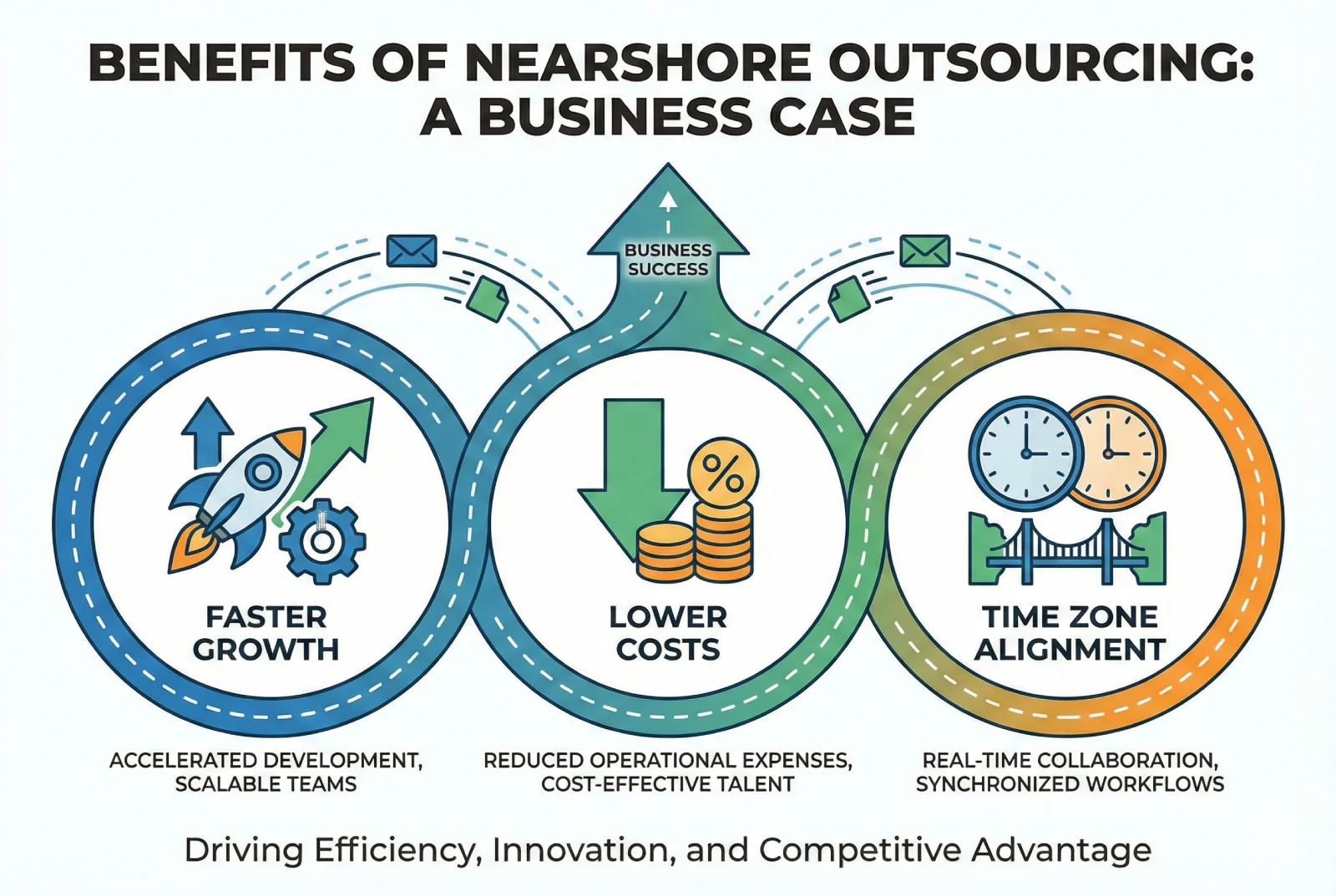
For executives in the validation stage, the real question is not if nearshore works — but when it delivers the strongest return on investment. Based on execution patterns across U.S. technology companies, nearshore consistently outperforms other models in scenarios where speed, flexibility, and financial control are critical.
✅ High-Growth Product and Engineering Teams
Fast-growing product teams need to scale engineering capacity without slowing down delivery. Nearshore enables rapid team expansion while maintaining real-time collaboration, agile execution, and product alignment.
Instead of pausing growth due to hiring bottlenecks or quality risks, nearshore allows leadership to sustain momentum — turning engineering into a growth accelerator rather than a constraint.
✅ Scaling Engineering Without Long-Term Hiring Commitments
In-house hiring creates long-term financial and organizational commitments that are difficult to reverse. Nearshore provides scalable capacity without permanent headcount risk.
This flexibility is especially valuable for CFOs and CTOs managing budget uncertainty, shifting roadmaps, or market volatility. Teams can scale up or down predictably, aligning costs directly with business needs.
✅ Modernization, Cloud, and Digital Transformation Initiatives
Modernization and transformation projects require specialized skills, tight coordination, and fast execution. Nearshore teams integrate seamlessly with internal stakeholders, reducing delays caused by time zone gaps or communication friction.
The result is faster modernization cycles, lower delivery risk, and higher ROI compared to offshore models — without the cost burden of building niche expertise in-house.
✅ Nearshore outsourcing delivers the highest ROI when companies need to move fast, stay flexible, and maintain control — making it a strategic advantage, not just a delivery model.
Key Takeaways for Executives Evaluating Nearshore Outsourcing
✅ Nearshore outsourcing offers a more balanced alternative to in-house and offshore models by combining cost efficiency, delivery speed, and operational control — without the long-term rigidity or execution friction of other options.
✅ Time zone alignment directly impacts productivity and speed. Real-time collaboration enables faster decisions, smoother agile execution, and shorter delivery cycles compared to offshore teams.
✅ Cost efficiency should be evaluated through Total Cost of Ownership (TCO), not hourly rates. Productivity, risk, rework, and management overhead have a greater financial impact than nominal cost differences.
✅ The nearshore partner you choose matters as much as the model itself. Senior talent, integration capability, and a product-focused delivery approach determine whether nearshore becomes a strategic advantage or just another vendor relationship.
Real-World Results: Nearshore Success Stories in Action
One of the strongest indicators of a successful nearshore strategy is its ability to deliver measurable outcomes across different industries and operating models. At MindTech, nearshore execution is validated through real-world results, not theoretical frameworks.
Enhancing Learning and Operational Efficiency in Higher Education
A leading private university in Latin America partnered with MindTech to modernize internal platforms and enhance the digital learning experience. By integrating nearshore engineering teams directly into their Agile workflows, the institution accelerated development cycles, improved system reliability, and reduced operational costs — all while maintaining close collaboration with internal stakeholders.
This engagement demonstrates how nearshore teams can operate as true extensions of in-house engineering in highly regulated, mission-critical environments.
Accelerating Retail Ecommerce with Automated Intelligence
In the retail sector, a large department store and Falabella faced growing challenges in scaling ecommerce content and product data quality. MindTech deployed nearshore teams specializing in AI, computer vision, and automation to streamline product information workflows.
The result was faster time-to-market, improved consistency across digital channels, and reduced manual workload for internal teams — showcasing how nearshore execution can directly impact revenue-driving operations.
Advanced Analytics Driving Quality and Efficiency in Automotive
For global automotive companies, MindTech supported the implementation of advanced data analytics and machine learning solutions focused on early fault detection and operational insights. Nearshore engineering teams worked in close alignment with U.S.-based product and operations teams, enabling rapid iteration and informed decision-making.
This case highlights how nearshore models can support complex, data-intensive initiatives without compromising quality, security, or delivery speed.
What These Success Stories Reveal About Nearshore Execution
Across education, retail, and automotive industries, a consistent pattern emerges: nearshore teams deliver the most value when they are embedded into product workflows, aligned with business hours, and accountable for outcomes — not just output.
These success stories reinforce that nearshore outsourcing, when executed correctly, is not a cost-saving tactic, but a strategic lever for scaling engineering capabilities with confidence.
Common Questions About Nearshore Outsourcing
What is an example of nearshore outsourcing?
An example of nearshore outsourcing is a U.S.-based company working with software development teams located in Latin America that operate in the same or similar time zones. These teams collaborate in real time, participate in daily agile ceremonies, and function as an extension of the internal engineering organization.
What is the difference between nearshore and offshore outsourcing?
The main difference between nearshore and offshore outsourcing is time zone and operational alignment. Nearshore teams work in overlapping U.S. time zones and share similar work cultures, while offshore teams often operate with significant time differences that create communication delays and execution friction.
Is nearshore outsourcing cheaper than hiring in-house in the U.S.?
In most cases, yes. Nearshore outsourcing reduces total cost of ownership by lowering fully loaded employment costs, accelerating hiring timelines, and maintaining high productivity — making it more cost-efficient than building and scaling in-house teams in the U.S.
What types of companies benefit most from nearshore outsourcing?
Nearshore outsourcing delivers the highest value for high-growth technology companies, product-driven organizations, and enterprises undergoing digital transformation that need to scale engineering capacity quickly without sacrificing speed, quality, or control.
How fast can nearshore software development teams be integrated?
Nearshore software development teams can typically be integrated within weeks, not months. Because of time zone alignment, strong communication skills, and familiarity with agile workflows, ramp-up times are significantly faster than with offshore outsourcing models.
Turning Nearshore Strategy Into Execution with MindTech
Understanding the benefits of nearshore outsourcing is only valuable if the strategy can be executed consistently and at scale. MindTech helps U.S. companies move from evaluation to execution by transforming nearshore strategy into high-performance engineering teams that deliver real business outcomes.
From Nearshore Concept to High-Performance Engineering Teams
MindTech works with U.S. technology leaders to translate nearshore strategy into day-to-day execution. Rather than adding isolated resources, MindTech builds nearshore teams that operate as a true extension of internal engineering.
These teams integrate into existing product, engineering, and delivery processes, sharing accountability for outcomes — not just output. The focus remains on velocity, quality, and long-term product success, ensuring nearshore becomes a growth enabler rather than a coordination challenge.
A Nearshore Outsourcing Model Built for U.S. Time Zones and Product Teams
MindTech’s nearshore outsourcing model is designed specifically for U.S. companies that rely on speed, collaboration, and continuous delivery.
Engineers work fully aligned with U.S. business hours, enabling real-time communication, faster feedback loops, and seamless participation in Agile, Scrum, and product workflows. Clear onboarding processes and structured integration ensure fast time-to-value, minimizing ramp-up time and delivery risk.
Why Companies Choose MindTech Over Generic Nearshore Vendors
Companies choose MindTech because execution quality matters as much as cost efficiency. MindTech provides senior, vetted engineering talent with strong communication skills and cultural alignment with U.S. teams.
Engagement models are transparent and designed for predictable scaling, giving leadership confidence and control as teams grow. This approach allows organizations to scale engineering capacity quickly while maintaining visibility, governance, and delivery excellence.
For U.S. technology leaders evaluating nearshore outsourcing, choosing the right partner is as important as choosing the right model. MindTech works with companies that need to scale engineering capacity efficiently, reduce delivery risk, and maintain full operational control — turning nearshore strategy into reliable execution.